May 28, 2026
We broke down the six most important steps you need to take to increase marketing funnel conversion rates — read on to unpack each one.

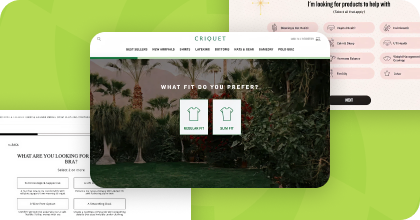
Build Your Own Product Quiz For Free Right Now
Simply give us your website URL and we will build you a completely on-brand product recommendation quiz for free.
Ecommerce marketing can get complicated fast. Between personalization, segmentation, customer acquisition, and figuring out how to actually use all the data you’re collecting, many brands end up juggling disconnected tools and missed opportunities, especially after the initial purchase.
That’s where Digioh and Klaviyo work well together. Digioh helps brands collect valuable zero-party data through quizzes, forms, and onsite experiences, while Klaviyo turns those insights into more personalized email and SMS campaigns that drive engagement, retention, and repeat purchases.
Instead of guessing what shoppers want, brands can create more relevant customer experiences across the entire lifecycle using data customers willingly share.

To help you make the most of this dynamic duo, we’ve outlined 6 steps to creating high-converting campaigns using Klaviyo and Digioh.
These are the same strategies leading DTC brands are using to boost conversions, grow their lists, and increase customer lifetime value (CLTV). Developing a comprehensive email strategy is essential for any ecommerce business looking to optimize and scale their marketing for profitability.
Email marketing remains one of the most effective revenue channels in ecommerce because it gives brands a direct, owned way to engage customers throughout the entire shopping journey.
The strongest ecommerce email marketing strategies are built on customer data. Purchase history, browsing behavior, zero-party data from quizzes and pop-ups, and customer preferences all help brands create more personalized campaigns that feel timely and relevant instead of generic.
That personalization powers everything from welcome flows and abandoned cart emails to post-purchase follow-ups, product launches, replenishment campaigns, and retention strategies. Instead of sending the same message to everyone, brands can deliver more targeted content, offers, and recommendations that improve engagement, repeat purchases, and customer lifetime value.
In this guide, we’ll break down the key strategies, automations, and personalization tactics that help ecommerce brands create email marketing campaigns that convert more consistently and build stronger long-term customer relationships.
Before building campaigns, get clear on your goals. Strong ecommerce email marketing isn’t about doing everything. It’s about focusing on the strategies that drive the most impact.
Instead of broad goals like “increase sales,” define measurable objectives tied to specific customer actions and business outcomes. Clear email marketing goals help shape everything from the data you collect to the campaigns, automations, and messaging you build.
Email campaigns also give brands more flexibility to deliver timely, relevant content at key moments throughout the customer journey. For example:
To hit these email marketing goals, identify which metrics you’ll track—such as conversion rates, average order value (AOV), retention rates, and revenue per recipient (RPR). Revenue per recipient (RPR) is calculated by dividing total email revenue by the total number of recipients, making it a key metric for measuring revenue efficiency at the recipient level and guiding strategic decisions. Each data point Klaviyo syncs and analyzes can provide actionable insights, helping you optimize automation, personalization, and campaign performance without manual data analysis. The clearer your goals, the easier it is to measure and improve performance.
Try this: Write out your primary goal for the next 90 days, list the metrics that will measure success, and identify one immediate action to take (e.g., launching a targeted pop-up campaign or A/B testing an email flow).
Your website is more than a storefront. It’s one of your biggest opportunities to build stronger customer relationships through personalization, engagement, and data-driven experiences that keep shoppers connected to your brand.
With Digioh, you can create personalized pop-ups and quizzes that guide shoppers, capture valuable zero-party data, and set the stage for more targeted email marketing campaigns. When designing pop-ups and quizzes, use compelling copy that highlights the benefits to the reader and encourages engagement.
How to use pop-ups effectively:
Start with a simple welcome pop-up or short quiz experience. Sync responses directly into Klaviyo to segment shoppers in real time and personalize follow-up campaigns automatically. Digioh’s templates also make it easier to launch faster without building everything from scratch.
For any ecommerce business, data is only valuable if it’s actively used to improve personalization, marketing performance, and customer experiences.
By syncing the insights you collect through Digioh directly into Klaviyo, you can enrich customer profiles and create hyper-targeted segments that make your campaigns smarter and more effective.
Segmentation helps ecommerce brands manage large subscriber lists more effectively by delivering more personalized experiences to both loyal customers and new subscribers, based on each shopper’s behavior, preferences, and relationship to the brand.
Klaviyo makes it easy to create segments based on behavior, preferences, product category, and quiz or pop-up responses, enabling more targeted campaigns. Today's best email marketers default to audience segmentation based on website behavior, marketing engagement, and app activity, with dynamic lists that automatically adjust based on subscriber activity.
Effective audience segmentation can include demographic, geographic, behavioral, psychographic, and technographic factors, allowing for highly personalized marketing strategies. Engagement tiers can be established by segmenting customers based on recency of activity to protect sender reputation.
Examples of segments (and how to create them):
Once you’ve collected the right data and built your segments, put them to work with automated Klaviyo flows like welcome series, abandoned cart emails, and post-purchase campaigns that feel more personal, timely, and relevant to each shopper.
Automated email flows can generate up to 30 times more revenue per recipient than standard email campaigns, and can account for 25-40% of total email revenue while requiring minimal ongoing maintenance. Klaviyo’s automated messaging can reportedly generate up to 20% of total revenue for ecommerce brands.
For advanced flows, use personalized marketing by segmenting customers based on behaviors, preferences, and purchase history to deliver highly targeted campaigns. Leverage predictive analytics—Klaviyo uses machine learning to assess a customer's lifetime value, predict their next order date, and identify churn risk—to optimize campaign timing and improve personalization.
Set up one automated flow in Klaviyo (like a welcome series) using Digioh's data. Pair it with a complementary SMS campaign to maximize engagement.
No campaign performs perfectly right away. Use A/B testing to identify what drives the strongest engagement, whether that’s your pop-up design, email copy, quiz flow, or offer strategy. Here are a few ideas worth testing:
Timing plays a major role in campaign performance. Use Klaviyo analytics and Digioh targeting to deliver messages when shoppers are most likely to engage, whether that’s a post-purchase upsell, browse abandonment follow-up, or time-sensitive promotion.
It’s also important to monitor core metrics like open rates, click-through rates, unsubscribe rates, and deliverability. Regularly removing unengaged subscribers helps maintain list health and improves the chances of your campaigns reaching the inbox consistently.
Pick one campaign element to test this week in your ecommerce business, such as pop-up copy or an email subject line. Use the results to refine your approach moving forward.
Long-term ecommerce growth comes from understanding what’s actually driving revenue and customer retention over time. Digioh and Klaviyo's email marketing reporting tools help brands track campaign performance, customer lifetime value, and revenue attribution so teams can see which emails, automations, and onsite experiences generate the strongest results.
With deeper customer data and behavior insights, brands can continuously refine segmentation, personalization, and automation strategies to improve engagement, repeat purchases, and overall marketing ROI within email campaigns.
What to do with these insights:
The more you know, the better you can tweak your strategy.
Schedule a monthly review of your metrics. Use the insights to identify one improvement to implement for the next 30 days.
If this feels overwhelming, the good news is you don’t need a massive team or complicated setup to make it work. Klaviyo and Digioh help simplify ecommerce marketing by combining customer data, personalization, and segmentation into automated flows.
Digioh makes it easy to collect zero-party data through quizzes, pop-ups, and onsite experiences, while Klaviyo turns those insights into targeted email and SMS campaigns that feel more timely and relevant to each shopper. Together, they integrate seamlessly with platforms like Shopify, BigCommerce, and WooCommerce to power more personalized customer journeys across the entire lifecycle.
From welcome flows and product launches to post-purchase campaigns, dynamic content, and retention strategies, the right automations help brands create stronger engagement and drive sales without adding more manual work.
These six steps are just the beginning. If you’re ready to go deeper with Klaviyo and Digioh, we’ve got you covered: The Ecommerce Marketer’s Guide to Zero-Party Data.
Inside, you’ll find tactical tips, real-world examples, and advanced techniques to help you simplify your strategy, deliver personalized experiences, and maximize your results.

Don’t settle for siloed tools. With Digioh, you get one powerful platform for pop-ups, product quizzes, onsite identification, and more—everything you need to personalize every step of the customer journey. Identify more traffic. Collect more zero-party data. Turn insights into revenue.