May 5, 2026
Looking for quiz inspiration? Here's our favorite ecommerce quizzes and what we love about them.

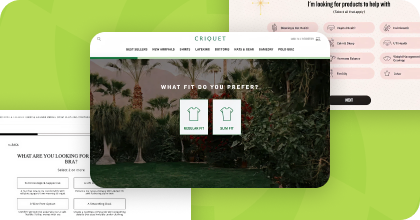
Build Your Own Product Quiz For Free Right Now
Simply give us your website URL and we will build you a completely on-brand product recommendation quiz for free.
Most ecommerce sites present every visitor with the same experience: the same homepage, the same product grid, and the same promotional banner. For a visitor who knows exactly what they want, that's fine. For the majority who don't, it's overwhelming.
Ecommerce quizzes solve this. Instead of asking visitors to self-navigate a catalog, well-designed interactive quizzes guide them through a series of targeted questions and surface products that match their needs. The result is a more personalized shopping experience that improves customer engagement and drives purchases.
But ecommerce quizzes do more than guide shoppers. Every interaction generates valuable data—including zero-party data and first-party data that customers willingly share. This data collection gives ecommerce brands deeper visibility into customer preferences, enabling more effective marketing strategies, enhanced customer satisfaction, and refined targeted marketing efforts.
Ecommerce quizzes are an interactive experience where customers answer questions about their needs, preferences, or goals. Based on those quiz answers, the system provides personalized recommendations that guide shoppers toward the right products.
Think of it as a digital personal shopper guiding customers through the shopping process, helping them find the right products faster, and boosting customer satisfaction.
These online quizzes work across industries—skincare, supplements, apparel, and more—anywhere understanding customer interest improves decision-making.
Too many options overwhelm shoppers. Ecommerce quizzes simplify the shopping journey by narrowing choices and helping customers find what they need faster. This improves the overall customer experience and increases customer satisfaction.
The interactive nature of quizzes keeps customers engaged. Instead of passively browsing, quiz takers actively participate, which can significantly boost customer engagement and increase time on site.
Each interaction contributes to quiz data—a highly accurate form of zero party data. Because customers willingly share their preferences, brands gain valuable insights into customer behavior and intent.
This type of customer data supports stronger marketing campaigns and better marketing efforts over time.
By delivering personalized recommendations based on targeted questions, ecommerce quizzes remove friction from the buying process. Engaging customers leads to higher conversion rates, increased average order value, and more loyal customers.
When customers answer questions, they become more invested in the quiz experience. Each step increases engagement and improves completion rates.
When quizzes provide meaningful recommendations, customers feel they’re receiving something useful from ecommerce brands. This increases willingness to share information and continue the customer interaction.
A well-structured product quiz removes uncertainty and improves the shopping experience. Instead of guessing, shoppers rely on the ecommerce quiz examples to guide them—improving confidence and increasing the likelihood they drive sales.
Every quiz decision — question structure, logic, results page design, email capture placement — should flow from a clear primary objective. Are you optimizing for immediate conversion? Email capture? Customer segmentation? The quiz that maximizes same-session purchases looks different from the one that maximizes list growth.
Most effective ecommerce quizzes serve multiple goals, but one should take priority. Successful marketing strategies include knowing which one to use before you start building.
Every question should connect directly to the recommendation logic. If the answer doesn't change what products get recommended, cut the question. Shoppers are giving you their time and attention — every question needs to justify its place.
Keep interactive quizzes to 5-8 questions. This range consistently produces the highest completion rates while collecting enough data to make accurate recommendations. Use multiple-choice questions over open-ended ones — open-ended questions have significantly higher abandonment rates on ecommerce quizzes.
Start with broad questions that help categorize the visitor, then use branching logic to get more specific based on their answers. A visitor who indicates they're a beginner shouldn't see the same follow-up questions as an experienced buyer. Branching logic creates a more personalized path without adding length.
Use image-based questions for style and preference categories. Showing options rather than describing them reduces cognitive load and keeps the quiz moving at a pace that maintains engagement.
Shoppers want to know how close they are to their results. A progress bar — or a creative version of one, like Andie Swim's swimmer that moves across the screen as visitors complete each question — reduces drop-off by showing visitors they're almost done. When someone can see they're one question away from their recommendation, they finish the quiz.
Andie Swim's progress bar is a good example of how a functional element can also be a brand moment for quiz takers. Their swimmer animation matches their site identity exactly — no generic progress bar in sight. The result: their quiz data powers automated Klaviyo email campaigns that produced a 55% increase in year-over-year email revenue.
The results page is where the quiz pays off and where most brands underinvest in their marketing strategies. A results page that simply shows a product misses the opportunity to explain why that product was recommended.
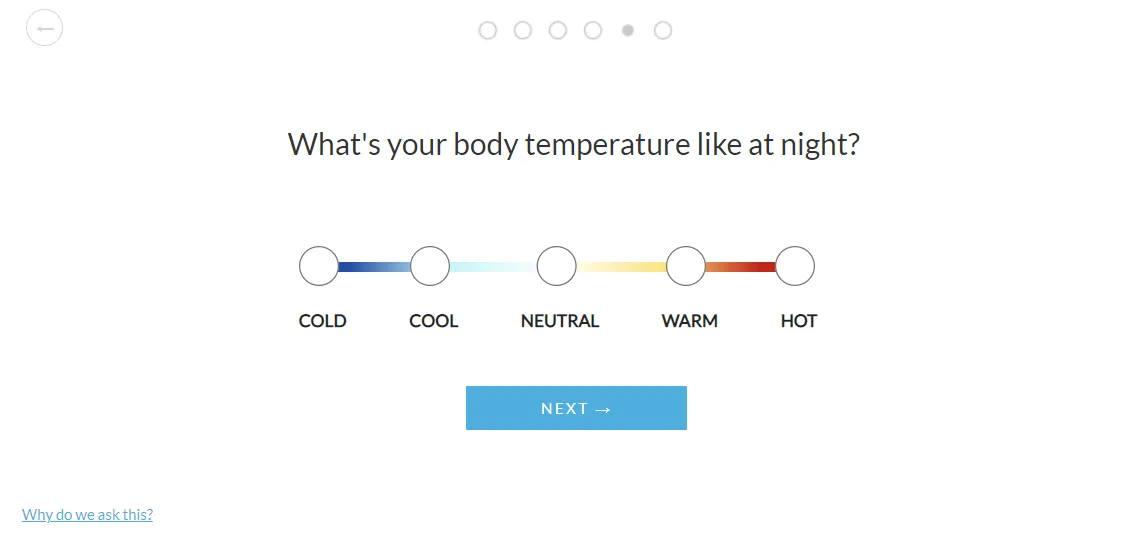
BEDGEAR's Pillow Finder quiz results page breaks down the reasoning behind every recommendation. Firm mattress? Their copy explains exactly how the recommended pillow works in harmony with it. Sleeps hot? They explain why their recommendation addresses that. Every quiz question is referenced in the results — demonstrating to the shopper that the recommendation was built specifically for them, not pulled from a generic algorithm.
This approach builds trust and directly impacts conversion during the shopping experience. Shoppers who understand why a product is right for them buy with more confidence and return it less often.
Limit recommendations to 3-4 products. More than that recreates the decision fatigue the quiz was designed to solve.
Willow's breast pump quiz is a good example of how education can be built into the quiz experience itself. After each answer, Willow displays a "Did you know?" fact about breastmilk and how their products help — delivering value to the customer in real time rather than waiting until the results page.

This approach builds trust and authority before any purchase decision is made. A brand that teaches you something useful before asking you to buy has established a very different relationship than one that simply presents products and prices.

Quizzes capture emails at 20-55%, significantly outperforming standard sign-up pop-ups. The reason is context — visitors are invested in getting their results, which makes the email ask feel like a fair exchange rather than an interruption.
The optimal placement for email capture is after the quiz questions but before the results are revealed. At this point, the visitor has already committed to the quiz and wants to see what it recommends — the motivation to provide their email is at its highest.
Make the skip option visible. Visitors who feel trapped into providing their email abandon the quiz entirely. A clear "skip" link keeps them moving toward the results and leaves the door open for future capture through other channels.
The real power of ecommerce quizzes lies in how you use the data from your engaging customers.
Email segmentation. Segment users based on customer preferences and behaviors to improve performance — fitness goals, skin type, sleep position, style preferences — and send communications that address each segment's specific needs rather than broadcasting the same message to your full list. Quiz-informed segments consistently outperform general list sends on open rate, click rate, and conversion.
SMS personalization. Use quiz data to tailor messaging and promotions. Pass quiz data to your SMS platform to send personalized product recommendations, restock alerts for relevant items, and promotional offers matched to stated preferences. A supplement subscriber who indicated they're focused on recovery receives different promotions than one focused on energy — and the relevance shows in engagement metrics.
Browse and cart abandonment recovery. When a known visitor who completed a quiz browses without purchasing, their quiz results can inform the browse abandonment email — featuring the products recommended for them rather than generic bestsellers. This level of personalization consistently outperforms standard abandonment emails.
Paid retargeting. Retarget potential customers using insights from customer behavior and quiz responses. Push quiz data to your ad platforms to retarget visitors with creative featuring their recommended products. Visitors who completed a quiz and didn't purchase are warm leads — retargeting them with their specific recommendations is more effective than showing them generic brand ads.
Social media. Quizzes are inherently shareable, so visitors who get results they find accurate or interesting naturally share them. Promoting quizzes in social content and paid social ads drives traffic that arrives with discovery intent, which is well-matched to the quiz experience.
A well-designed quiz with a clear value proposition doesn't need much incentive to drive completion — the personalized recommendation is the incentive. But a few additional tactics consistently improve completion rates and conversion from results.
Time-limited discount on results. Offering a discount code that expires within 24-48 hours on the results page creates urgency without putting pressure on the user. The visitor already has their recommendation; the discount is just the push to act on it now rather than later.
Save results to email. Framing the email capture as a way to save and return to results is a lower-pressure ask than a discount exchange. Some visitors who won't submit an email for a coupon will submit it to preserve their personalized recommendations.
Personalized post-quiz email sequence. The first email after a quiz — triggered immediately with the visitor's results and recommended products — is consistently the highest-performing email in most brands' sequences. It arrives when the recommendation is fresh and purchase intent is at its highest.
Quiz data is zero-party data (customers willingly provide it), but that doesn't exempt you from your compliance obligations. Follow these practices to collect quiz data responsibly:
Include a consent checkbox for marketing communications, separate from the quiz completion itself. Be transparent about how quiz data will be used, as customers who understand the value exchange (personalized recommendations and relevant marketing in exchange for their preferences) are more willing to share accurate information. Implement appropriate security measures to protect stored quiz data. Work with your legal team to ensure your data collection and usage practices comply with applicable regulations in the regions where you operate.
Transparency builds trust and fosters customer loyalty. Brands that are clear about why they're asking for information and how they'll use it collect better data and maintain stronger customer relationships over time.
Quizzes from ecommerce stores are among the highest-ROI tools available to ecommerce marketers; they convert better than static product pages, collect better data than behavioral tracking, and build stronger customer relationships than generic email campaigns.
Building a quiz strategy that actually works requires the right platform. Digioh gives you complete control over quiz process and design, branching logic, results page customization, and integrations with your full marketing stack — Klaviyo, Attentive, Salesforce, and 200+ other tools — without usage caps or cookie-cutter templates.
Looking for inspiration before you build a product recommendation quiz with Digioh? Browse 50+ real quiz examples from leading DTC brands to see what high-performing quizzes look like across categories.
Ready to build your own? Book a demo to see how Digioh can help you launch a quiz that drives sales and collects the data that powers everything downstream.
Don’t settle for siloed tools. With Digioh, you get one powerful platform for pop-ups, product quizzes, onsite identification, and more—everything you need to personalize every step of the customer journey. Identify more traffic. Collect more zero-party data. Turn insights into revenue.