May 5, 2026
Discover how to create a custom product recommendation quiz totally tailored to your brand.
Steal High-Converting Ideas From Leading DTC Brands
Browse 50+ real examples of personalized marketing funnels you can replicate today.
When Andie Swim launched their swimsuit style quiz, it became one of their highest-converting pages almost immediately. Quiz takers answered a few questions about body type, style preferences, and how they planned to use the suit. The recommendations felt personal. The experience felt like Andie.
That result is not accidental. The quiz worked because it felt fully integrated into the brand experience, not like a third-party tool layered on top. That distinction is what separates a quiz that converts from one that gets ignored.
This guide breaks down what makes a product recommendation quiz feel on-brand, how to build one that aligns with your identity, and what to measure after launch.
A branded product recommendation quiz guides shoppers toward the right products while reflecting your brand's look, feel, and voice throughout the entire experience, from the first question to the results page.
The branded part is what separates high-performing quizzes from forgettable ones. Every detail — button colors, typography, question phrasing, results copy — should feel consistent with the rest of your site and marketing. That consistency builds trust. When the experience feels like it belongs to your brand rather than a generic quiz template, shoppers are more likely to complete it and act on the recommendations.
RANAVAT's Skincare Ritual quiz is a good example. The colors, typography, and imagery all match their Ayurvedic skincare identity. The copy speaks in the same tone as their product pages. Nothing feels out of place, and that cohesion directly supports conversion.

A well-branded quiz delivers three things simultaneously: a tailored shopping experience, stronger brand recognition, and zero-party data that powers every downstream marketing touchpoint.
Most quiz tools make it easy to launch something. They're harder to make feel like yours.
Obvi saw an opportunity to improve their quiz experience. Their original version was functional, but it didn’t fully reflect the brand. Completion rates were around 45%.
After exploring what other brands were doing, they realized how much more impactful a quiz could be when it felt truly on-brand. That led them to Digioh.
“We started noticing other brands with incredible quizzes,” said Ronak Shah, Founder & CEO of Obvi. “We thought, ‘There’s no way all these brands went custom.’ That’s when we found Digioh. It was a ‘where have you been?’ moment.”

After rebuilding with Digioh — bold design, playful tone, branching logic tailored to shopper goals — completion rates jumped to 80%, and conversions increased by 102%.
The quiz content barely changed. The brand execution changed everything.
When a quiz matches your site’s look and voice, shoppers don't feel they are being handed off to a different tool. The experience stays immersive, trust stays intact, and that trust carries through to the recommendations, which ultimately drives the sale.
Building a quiz that converts is one thing. Building one that feels like you is another. Here’s how to create a quiz that not only delivers the right recommendations, but also reinforces your brand at every click.
Start by clarifying the goal. Is the quiz meant to build purchase confidence, capture email and SMS subscribers, segment customers, or drive immediate conversions?
Your goal shapes everything — the question structure, where the email capture lives, what the results page prioritizes, and how you follow up. A quiz built to capture leads looks different from one built to drive same-session purchases. Know which one you're building before you start.
A quiz that converts mirrors how your customers think and shop. Use your existing customer data, post-purchase survey responses, and on-site behavior to inform how you frame questions.
If your brand attracts eco-conscious shoppers, give them a way to express their priorities so their results align with them. If your customers are experienced, move past the basics and focus on what sets their needs apart. The quiz should feel informed by a deep understanding of your customer, not a generic template.
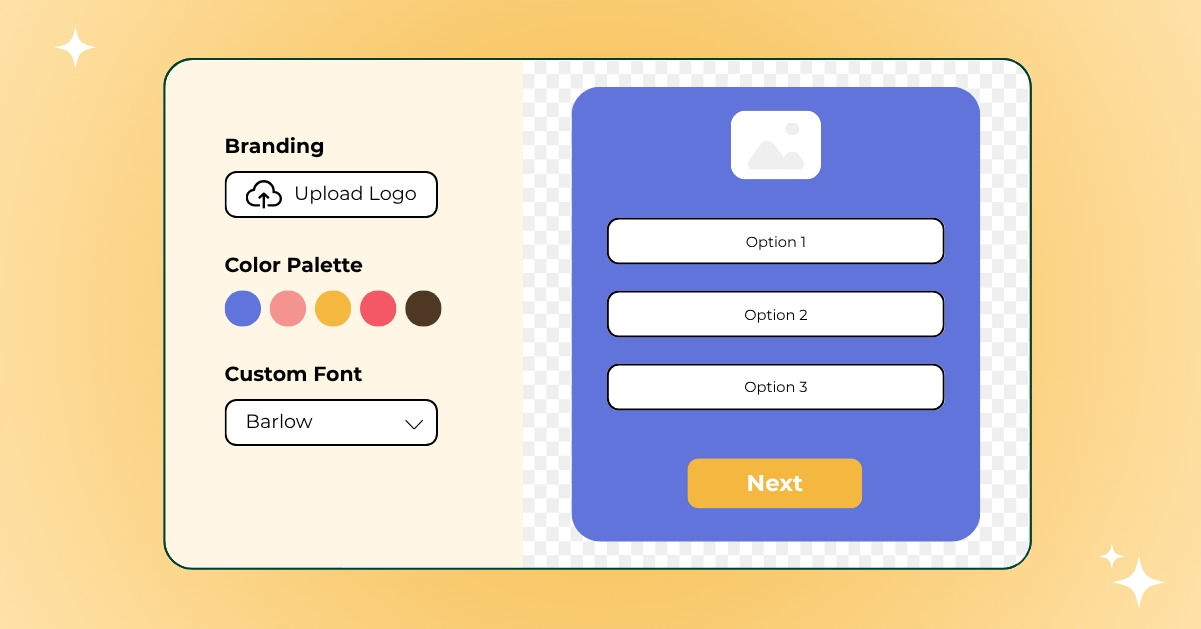
Carry your brand guidelines into every quiz element: fonts, colors, button styles, imagery treatment, and progress bar design. Match your photography style and product presentation so nothing feels out of place.
Equally important: write in your brand's voice. A playful DTC supplement brand sounds different from a heritage luxury skincare brand, even if both quizzes have identical structures. Tone of voice is part of the brand experience. A quiz written in generic, neutral language signals to the shopper — however subtly — that this isn't really part of your brand.
Before launch, review your quiz alongside your homepage and product pages. If any part of it looks like it could belong to another brand, it needs refinement.
Every question should connect directly to the recommendation logic. If the answer doesn't change what products get recommended, cut the question. Shoppers are giving you their time and attention — every question needs to justify its place.
Keep the quiz to 4-8 questions. Quizzes in this range consistently outperform longer ones on completion rate. Use branching logic to personalize the path based on previous answers — a shopper who indicates sensitive skin shouldn't see the same follow-up questions as someone with oily skin.
For style and preference-based categories, image-based questions tend to outperform text-only options. Showing rather than describing reduces cognitive load and keeps the experience moving.
Avoid generic filler questions that could appear on any brand's quiz. Every question should feel like it could only come from you.
The results page is where the quiz pays off and where most brands underinvest.
Don't just show a product. Explain why it was recommended based on the shopper's specific answers. Connect the recommendation back to what they told you. Shoppers who understand why a product is right for them buy with more confidence and return less often.
Limit recommendations to three or four products. Anything more can reintroduce the same decision fatigue the quiz is meant to remove.
If your brand is known for sustainable materials, reflect that in your results copy. If your voice is warm and encouraging, the results page should feel the same. The recommendation is the payoff, so it should sound like your brand.
With Digioh, your product feed syncs directly, keeping recommendations accurate as inventory changes without manual updates.
A significant portion of your quiz traffic will come from mobile. Design for mobile first, not as an afterthought. Buttons need to be easily tappable, text needs to be readable without zooming, and load times need to be fast.
Test on multiple devices before launching because what looks polished on a desktop can feel clunky on a phone in ways that aren't obvious until you're actually using it. A quiz that frustrates mobile users loses the majority of your potential quiz-takers before they reach the results.
A great quiz only works if people see it. Launch it where your audience already engages, including welcome emails, Instagram Stories, homepage banners, product category pages, and exit-intent pop-ups for visitors who are about to leave.
The more natively the quiz appears in each channel, the more likely people are to engage with it. A quiz promoted in a welcome email should feel like a natural extension of that email's tone and offer, not a jarring redirect to something that feels unrelated.
Once live, review completion rates, drop-off points, and which results convert best. A/B test design and copy changes. Use those insights to refine both performance and brand consistency over time.
Connect your quiz to your broader tech stack — Klaviyo, Attentive, Salesforce, or whatever tools you're already using — so the zero-party data collected flows directly into your campaigns and automations.
Most teams treat a quiz build like a marketing task. The brands that get the best results treat it like a brand project. Before your team starts building, pull together the same assets you'd give any agency or designer working on your brand:
Bring these into the quiz build from day one. The brands that end up with generic-feeling quizzes are almost always the ones that started building before they answered these questions.
Consistency matters more than people think. Your quiz should feel like a natural extension of your site, not a separate experience. Fonts, colors, button styles, and imagery should all align. When something feels off, even slightly, trust drops and engagement follows.
Voice is just as important as design. Every part of the quiz should reflect your brand, including answer choices, results copy, and button text. These details shape how the experience feels and whether shoppers stay engaged.
Personalization should come from relevance, not complexity. Use branching logic to guide shoppers based on their answers and keep the experience focused. The goal is to make each path feel intentional without adding friction.
Data should be handled with clarity and purpose. Be transparent about what you are collecting and why. Follow GDPR and CCPA requirements, and make it clear how the data will be used. When shoppers understand the value exchange, they are more likely to engage and return.
Inconsistent branding. Off-brand colors, mismatched imagery, or a shift in tone can quickly break the experience. Even small inconsistencies signal to the shopper that the quiz is not fully part of your brand. Review your quiz alongside your site before launch to ensure everything feels aligned.
Generic questions. When questions are too broad, the results feel generic. Each question should be grounded in your product catalog and the real factors your customers consider before buying.
Neglecting mobile. This is one of the most common execution issues. Test on real devices, not just by resizing your browser. Navigation, tap targets, load times, and image rendering all behave differently on actual phones.
Burying the results. If the results page falls short, the entire quiz does too. Give it the same level of attention as your questions.
Once your quiz is live, keep an eye on both engagement and conversions. Completion rate, time spent, and clicks on results show how well it holds attention.
From there, track how many quiz takers make a purchase, add items to their cart, or sign up for email and SMS. Compare these numbers to your site averages to see the direct impact.
If your quiz collects preferences, measure how those insights improve your marketing. For example, check how targeted email flows based on quiz data perform compared to general sends.
With tools like Digioh’s analytics dashboard and Google Analytics, you can spot trends, see what’s working, and adjust for better results.

ThirdLove’s Bra Finder quiz reflects its in-store fitting experience online. The body-positive, reassuring language stays consistent across the entire site, with no shift in tone between product pages and the quiz. Clean visuals and supportive copy help reduce friction around what can be an uncertain purchase. The result is an experience that feels like a natural extension of the brand, not a separate conversion tool.
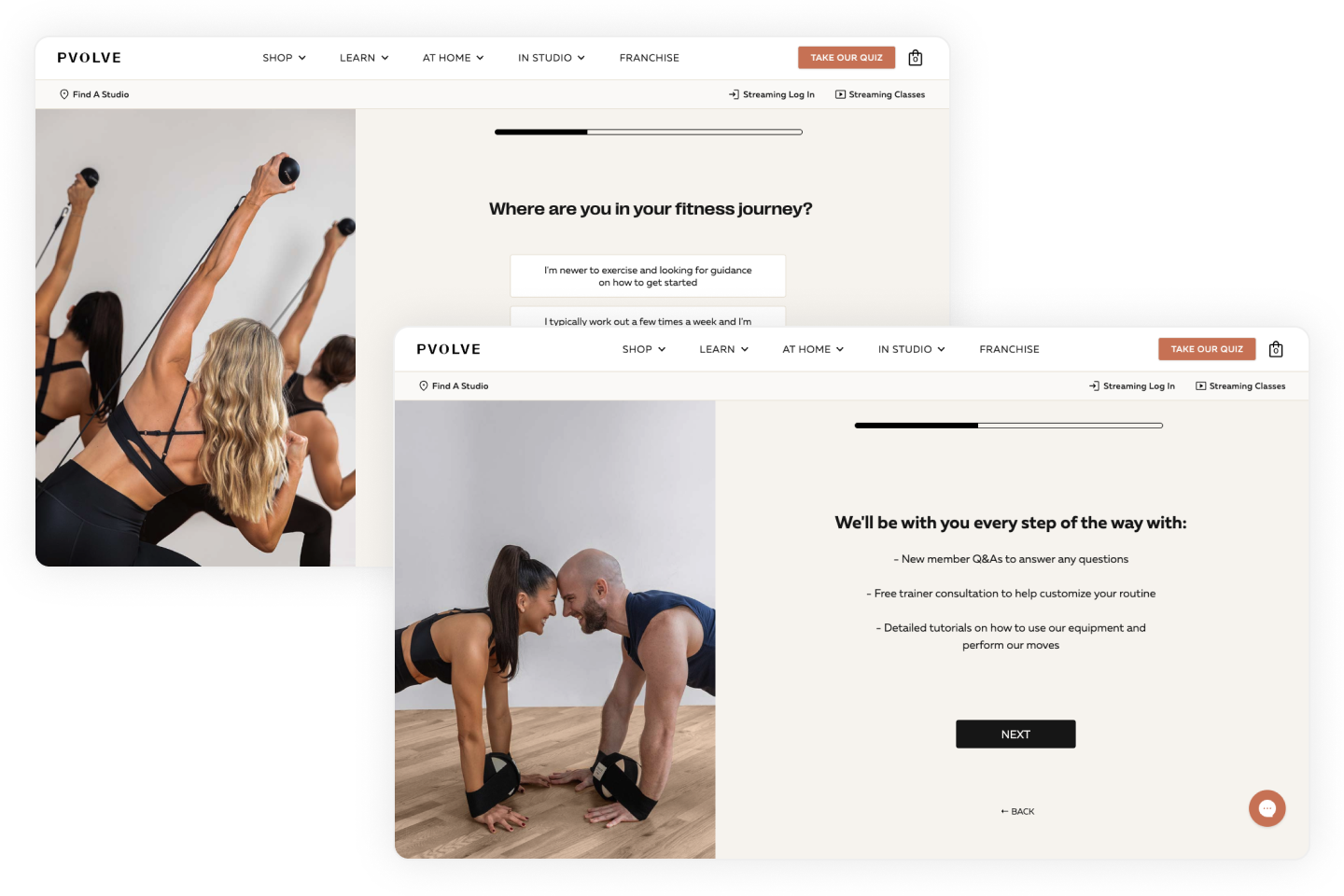
Pvolve uses its quiz to reflect their premium, science-backed positioning at every step. The sleek design, precise language, and progressive question flow mirror the elevated, intentional feel of their brand. It's approachable enough for beginners without talking down to experienced athletes — a balance their product marketing already strikes, and the quiz carries it through.

Dollar Shave Club stays true to its voice from start to finish. The tone is witty, direct, and unpretentious, with short, punchy copy and bold visuals that keep the experience quick and engaging. It feels unmistakably like Dollar Shave Club, which is exactly why it works.
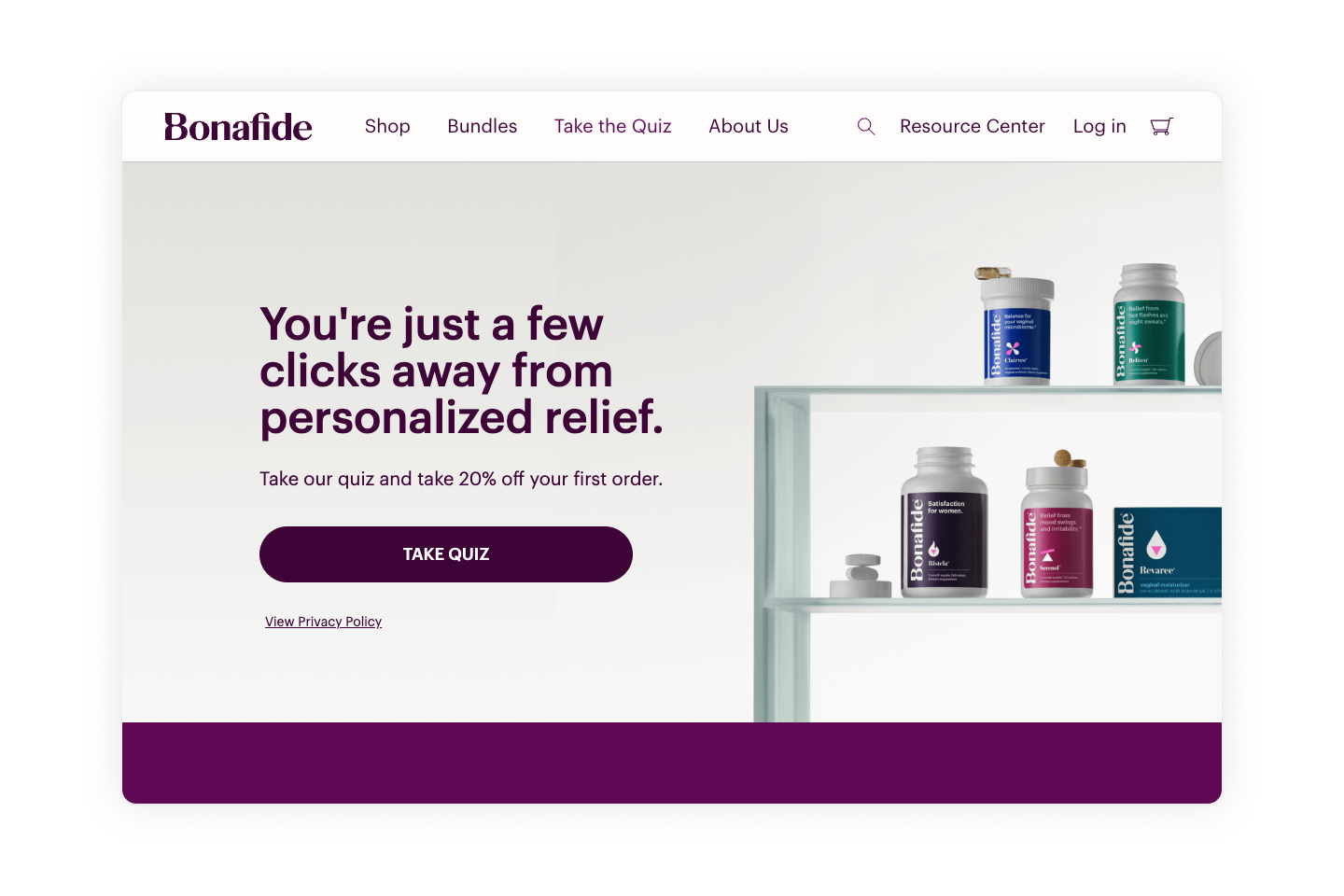
Bonafide’s quiz addresses a sensitive topic with the same respectful, clinically informed tone that defines the brand. The questions are thoughtful and informative without feeling cold or overly technical. The design is warm and consistent with their packaging and site experience. Every detail reflects a clear understanding of their customers, which drives trust and conversion.
Completion rate — Target 70% or higher as a baseline. Below that, look for drop-off points in your analytics. The issue is usually a question that feels irrelevant, a design element that creates friction, or a quiz that's simply too long.
Email and SMS capture rate — Benchmark against 20-55%. If you're below that range, test the placement, framing, and value proposition of your capture ask.
Conversion rate vs. site average — This is your clearest signal of quiz ROI. Quiz-driven traffic should convert at a rate meaningfully higher than your site's average. If it doesn't, the results page is usually where the problem lives.
Average order value — Quiz-driven purchases should show higher AOV. If they don't, your results page may not be doing enough to surface complementary products or higher-value options.
Downstream email and SMS performance — Track how segments built from quiz data perform against your general list. Better open, click, and conversion rates from quiz-informed segments validate the zero-party data strategy.
A well-branded quiz does more than guide shoppers to the right product. It extends your brand experience into one of the most important moments in the customer journey, when someone is deciding what to buy.
When every detail, from the first question to the results page, reflects your brand, the experience feels cohesive. Shoppers leave with more confidence in their decision, stronger trust in your brand, and a higher likelihood of returning.
With Digioh, you have full control over design, logic, and integrations. There are no usage limits or generic templates. Our team works with you from onboarding through launch and beyond to ensure your quiz looks right, feels right, and performs as expected.
Book a demo to see how Digioh can help you build a quiz that's unmistakably your brand.
When a quiz reflects your brand’s look, feel, and tone, it creates a consistent experience that feels familiar and trustworthy. That consistency keeps shoppers engaged, increases completion rates, and makes them more likely to act on the results.
Digioh gives you full control over design, logic, and integrations, so your quiz looks and functions exactly as you intend. Our team supports you through onboarding, design, and launch, then continues working with you as you optimize performance over time.
Zero-party data is information shoppers choose to share through their quiz answers. With Digioh, you can capture detailed data points and sync them directly to your ESP, CRM, or SMS platform, making it easier to run targeted, personalized campaigns.
Yes, and the impact can be significant. Bonafide’s Digioh-powered quiz increased onsite conversion rates by 469%. Obvi saw a 102% increase in conversions after rebuilding their quiz with stronger branding and logic.
Start with your existing brand guidelines, including fonts, colors, imagery, and voice. Apply those consistently throughout the quiz. Treat the quiz like any other brand experience and review it alongside your live site before launch to ensure it feels cohesive.
Don’t settle for siloed tools. With Digioh, you get one powerful platform for pop-ups, product quizzes, onsite identification, and more—everything you need to personalize every step of the customer journey. Identify more traffic. Collect more zero-party data. Turn insights into revenue.

<script type="application/ld+json">{ "@context": "https://schema.org/", "@type": "BreadcrumbList", "itemListElement": [{ "@type": "ListItem", "position": 1, "name": "Blog", "item": "https://www.digioh.com/blog" },{ "@type": "ListItem", "position": 2, "name": "How to Create a Custom, Branded Product Recommendation Quiz", "item": "https://www.digioh.com/blog/custom-product-recommendation-quiz" }]}</script>
<script type="application/ld+json">{ "@context": "https://schema.org/", "@type": "HowTo", "name": "Create a custom product recommendation quiz", "step": [{ "@type": "HowToStep", "text": "Step 1: Align Quiz Goals With Brand Objectives", "name": "Before you start drafting questions, get clear on what the quiz should accomplish for your brand." },{ "@type": "HowToStep", "text": "Step 2: Understand Your Brand’s Audience", "name": "A good quiz mirrors how your customers think and shop. Use your customer data, feedback, and on-site behavior to guide how you frame questions." },{ "@type": "HowToStep", "text": "Step 3: Design a Brand-Consistent Quiz Experience", "name": "From button colors to typefaces, carry over your site’s look and feel. Match your photography style and product presentation so nothing feels out of place." },{ "@type": "HowToStep", "text": "Step 4: Craft Brand-Relevant Questions", "name": "Focus on what matters most to your customers when choosing a product in your category." },{ "@type": "HowToStep", "text": "Step 5: Map Results to Brand-Aligned Products", "name": "Link quiz answers to products that reflect your brand’s positioning. If you’re known for sustainable materials, feature those in the recommendations and highlight that in the copy." },{ "@type": "HowToStep", "text": "Step 6: Optimize for Mobile and Brand Consistency", "name": "Many shoppers will take your quiz on their phone, so test it on multiple screen sizes. Keep the design polished, the navigation simple, and the load times quick." },{ "@type": "HowToStep", "text": "Step 7: Promote Your Branded Quiz", "name": "Launch your quiz where your audience already engages with you, whether that’s in a welcome email, an Instagram Story, or a homepage banner." },{ "@type": "HowToStep", "text": "8: Test and Refine for Brand Impact", "name": "Once your quiz is live, review analytics to see where people drop off, which results convert best, and how different design or copy changes affect engagement. Use those insights to fine-tune both performance and brand feel over time." }] }</script>
<script type="application/ld+json">{ "@context": "https://schema.org", "@type": "FAQPage", "mainEntity": [{ "@type": "Question", "name": "How does branding a quiz improve customer engagement?", "acceptedAnswer": { "@type": "Answer", "text": "When a quiz matches your brand’s look, feel, and tone, it creates a consistent experience that feels familiar and trustworthy. That familiarity keeps shoppers engaged and more likely to complete the quiz." } },{ "@type": "Question", "name": "How can Digioh help create a branded product recommendation quiz?", "acceptedAnswer": { "@type": "Answer", "text": "Digioh gives you complete control over design, logic, and integrations, so your quiz looks and works exactly the way you want. Our team also provides onboarding, design support, and best practices to get you live quickly." } },{ "@type": "Question", "name": "How does a branded quiz collect zero-party data?", "acceptedAnswer": { "@type": "Answer", "text": "Zero-party data is information shoppers willingly share with you through their quiz answers. With Digioh, you can capture 50+ data points per user and sync them directly to your ESP, CRM, or SMS platform for targeted campaigns." } },{ "@type": "Question", "name": "Can branded quizzes improve e-commerce conversion rates?", "acceptedAnswer": { "@type": "Answer", "text": "Yes. Many brands see significant lifts in conversions after launching a branded quiz. For example, Bonafide’s Digioh-powered quiz increased onsite conversion rates by 469%." } },{ "@type": "Question", "name": "How do I ensure my quiz aligns with my brand’s aesthetics?", "acceptedAnswer": { "@type": "Answer", "text": "Start with your existing brand guidelines (fonts, colors, imagery, and voice) and carry them into every quiz element. A customizable platform like Digioh makes it easier to match those details exactly" } }]}</script>