November 5, 2026
A sourced comparison of Retention.com alternatives for Shopify and Klaviyo brands, with pricing as published and what each tool does after a visitor is identified.
Build Your Own Product Quiz For Free Right Now
Simply give us your website URL and we will build you a completely on-brand product recommendation quiz for free.
The best Retention.com alternative depends on what you want identification to do once a visitor is recognized. If the goal is net-new email contacts in Klaviyo, Opensend, Tie and Customers.ai are the closest direct alternatives. If you want a managed retention program at enterprise scale, look at Wunderkind. If you want identification that also changes what shoppers see on your site, with quizzes, pop-ups and Digioh Passport in one platform, Digioh is the alternative built for that. If you are not ready to switch, you can also run Digioh alongside Retention.com and compare the two.
Digioh wrote this guide, so we have a point of view. We built it from each vendor's own website and documentation, reviewed in November 2026, and we marked what a vendor does not publish instead of guessing. Match rates below are the vendors' own claims, and we found no independent benchmark that compares them. For a wider category view, see our visitor identification software buyer's guide.
Last updated November 2026.
Retention.com describes itself as the identity data company. Its site says one tag resolves anonymous traffic to a person with consent-aware signals, and it reports more than 250M US identities, 5,500 customers and SOC 2 Type II certification. Its Klaviyo integration sends contacts it acquires into Klaviyo and suppresses profiles Klaviyo already has, both subscribed and unsubscribed. These figures are Retention.com's own.
Teams usually start comparing for a few practical reasons. Retention.com does not publish prices or a match rate on its site. The pages we reviewed describe activation through your email platform, and they do not describe changing what a shopper sees while they are still browsing. And some teams want to see how matching is measured before they commit to an annual contract.
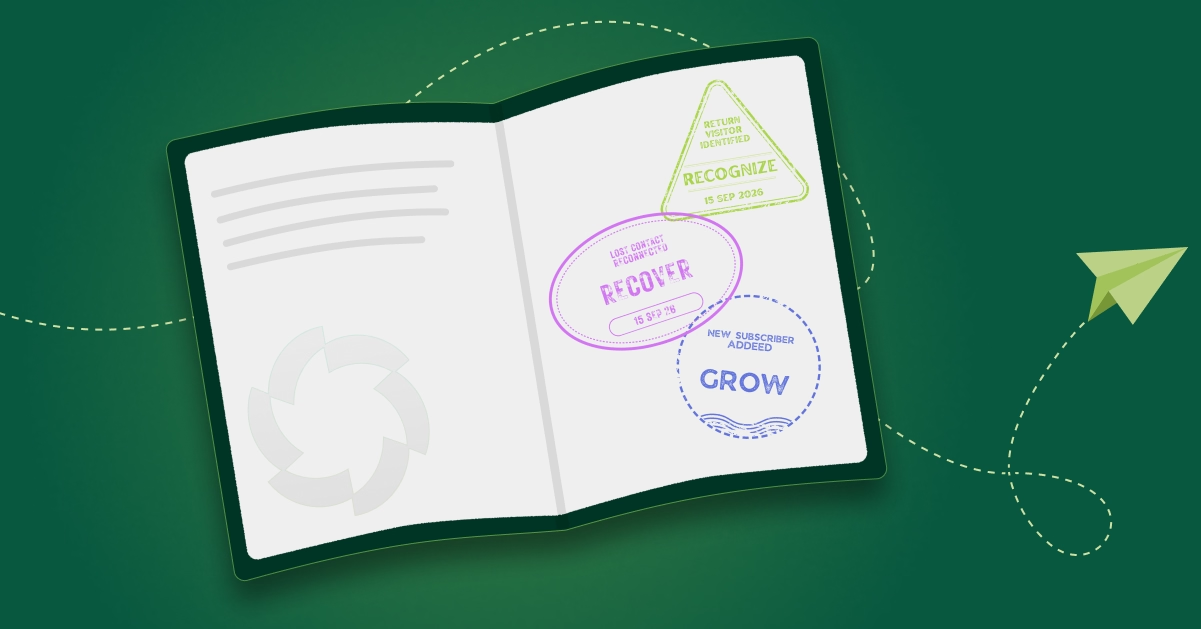
Digioh Passport is an identification suite with three parts. Recognize re-identifies returning visitors using the signals from your own data, so a cookie expiring does not send a known shopper back to zero. Recover extends that reach through the Digioh Identity Network, Digioh's consent-based identification network, so visitors who have gone anonymous are identified again, including contacts that email can no longer reach. Recover works on contacts you already have and adds no new opt-ins. Passport Grow, which brings in net-new subscribers, is currently in beta. Retention.com also sells a product called Grow, so this guide says Digioh Passport Grow to keep them apart.
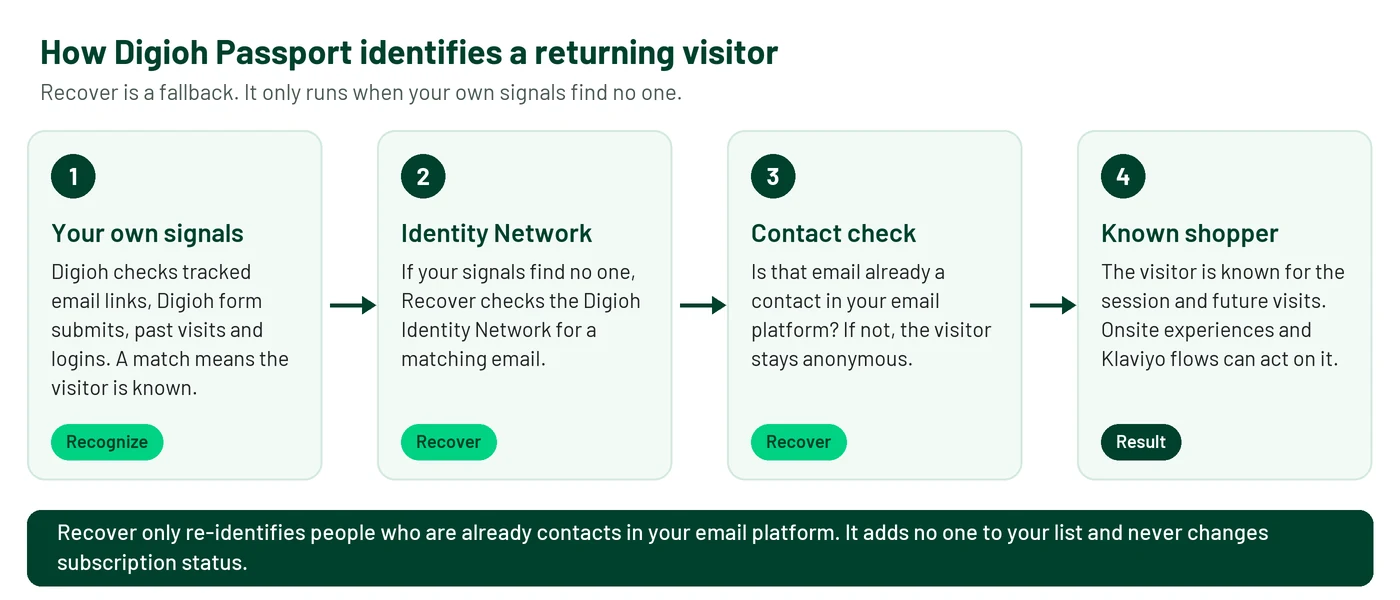
What sets Passport apart is what happens next. Once a shopper is recognized, Digioh can change the site experience while they are still browsing, with different banners, product recommendations, offers and quiz resumes for known and unknown visitors, and the same identity syncs to Klaviyo for lifecycle flows. Recognize works with Klaviyo, Iterable, Braze, Dotdigital and Ometria. Recover is available for Klaviyo and Iterable and is enabled on request through your Digioh team.
Digioh runs on Shopify and Shopify Plus, along with BigCommerce, WooCommerce and headless builds, and brands such as Pressed run it on a Shopify storefront alongside Klaviyo. Pricing starts at $500 a month based on site traffic, month to month with no long-term contract, and every plan includes the full platform: pop-ups, quizzes, Passport and onboarding.
The tradeoff is focus. If your only goal is to add as many net-new email contacts as possible today, the append tools below are built specifically for that, and Digioh's net-new capability, Passport Grow, is still in beta. Digioh is strongest when you want identification to change the experience, not only feed an email list. See the Digioh Passport page for how Recognize, Recover and Grow work.
Opensend says it identifies and converts engaged visitors using a proprietary identity graph, installed with a pixel or the Shopify app, and it connects to your email marketing platform. Its homepage claims 180M US shoppers in its network and a 73% US shopper match rate. It also publishes a trial, which is $1 for two weeks.
Opensend fits brands that want to test identification quickly and cheaply. The tradeoffs to check are how its match rate is measured, since it is self-reported, and which of its products you need, because its capabilities are split across Connect, Reconnect and Ignite. For a direct comparison, read Digioh vs Opensend.
Tie matches server-side signals such as IP, device and hashed email against a consumer identity graph, and it syncs a profile to your email platform only when the match clears a confidence threshold. It is built around Klaviyo, where it describes itself as a Klaviyo Preferred Tech Partner. Confirm support for any other email platform with Tie directly.
Tie says it can identify up to 70% of your shoppers, calls 70% a ceiling, and cites customers seeing 20% to 45%. Its own blog frames the figure as up to 70% of total site traffic and 90% or more of returning shoppers, so compare match rates only when vendors measure them the same way. The main constraint is eligibility. Tie sets minimum traffic and CRM size thresholds and sells annual contracts with usage-based credits, so confirm your store qualifies and model the cost at your volume. That points it toward larger Klaviyo brands.
Customers.ai identifies visitors with its X-Ray pixel. Its Shopify App Store listing shows a Starter plan at $199 a month plus $0.23 per contact captured, Pro at $399 plus $0.18, and Advanced at $799 plus $0.13, and its pricing page says plans scale with the total number of Klaviyo profiles. It claims most visitor ID solutions get identities right 5% to 30% of the time and that its own approach is 2x to 7x more accurate, which is its own claim and not an independent result.
Usage-based pricing keeps the entry cost low and lets you start small. The tradeoff is that per-contact charges grow with volume, so model the cost at your real traffic before you choose it.
Wunderkind is an identity-driven decisioning platform offered as self service, fully managed or hybrid. Its site says it can identify 2x to 4x more traffic than any ESP or CDP and reports more than 700 brands. It does not publish pricing. It has announced integrations with Ometria, Iterable and SAP Engagement Cloud, each pitched as resolving anonymous traffic inside the email platform you already use, and the pages we reviewed do not describe a Shopify or Klaviyo integration, so confirm both during evaluation.
Wunderkind fits larger brands that want a managed program run for them. Digioh's own comparison covers where the two differ: Digioh vs Wunderkind.
Instant is an AI email and SMS platform. Its Instant Audiences feature re-identifies opted-in shoppers who leave without buying and triggers Instant's AI flows, and it claims 2x to 3x more abandoned browse, add to cart and checkout started events. The pages we reviewed do not list pricing.
Because Instant Audiences feeds Instant's own flows, confirm how identified shoppers reach Klaviyo if your lifecycle program runs there. It fits teams that want to move their email and SMS program onto Instant as well.
Yes. Passport Recognize and Recover work with the contacts already in your email platform, and Recover does not add anyone to your list, change anyone's subscription status, or override your suppression rules. That makes it practical to run next to Retention.com or another identity tool while you compare results, and some brands run both side by side before they decide whether to consolidate.
Digioh's help documentation covers the setup. You clone your Klaviyo flows for Passport, then exclude the Digioh metrics in the filters of your existing flows so a shopper does not receive duplicate messages. Passport also has a setting that forwards events to Klaviyo only for the visitors Digioh identifies first, which keeps your Passport flows focused on the audience it added and gives you a clean read on the lift. See how to clone Klaviyo flows for Digioh Passport and the Passport Recover guide.


Klaviyo's help documentation explains that anonymous activity is held in the browser's local storage and attached to a profile only after an identifying action, such as a form submission, a click from a Klaviyo email, an Identify API call or a checkout. Klaviyo does not identify anonymous visitors by itself, and it notes that Safari can clear local storage after seven days. That gap is why this category exists. Read the details in Klaviyo's article on anonymous activity.
Start with the job you want identification to do. If you want more contacts for email and SMS, the append tools are the closest match. If you want a managed retention program, look at Wunderkind. If you want recognized shoppers to see a different site, and you want quizzes and pop-ups tied to the same identity, look at Digioh Passport.
Whichever vendors you shortlist, ask each of them the same questions:
PrettyLitter used Digioh Passport to recover 496,000 visitor identities and sync them to Klaviyo. Digioh-engaged traffic converted at 7.8% against a 1.3% site average, and over one year its pop-up variants generated $1.1 million in attributed revenue and drove 70% of new US email subscribers. Matthew Seifert, Vice President of CRM and Loyalty at PrettyLitter, said, "Once we could actually identify who was coming to our site, everything clicked." Read the full PrettyLitter story.

Pressed came to Digioh for a quiz and found identity was the bigger driver. In its first six months, visitors who engaged with a Digioh campaign accounted for 20% of Pressed's total site revenue, and shoppers who bought after taking the quiz had a 46% higher average order value. Daniel Washburn, Director of Ecommerce at Pressed, said, "Identification was just a nice-to-have. But we've realized identity is the big revenue driver for us." Read the full Pressed story.
It depends on the job. Opensend, Tie and Customers.ai are the closest alternatives for adding net-new email contacts in Klaviyo. Wunderkind suits larger brands that want a managed program. Digioh Passport suits brands that want identification to change the onsite experience as well as feed email and SMS.
Yes. Passport Recognize re-identifies returning visitors from the signals in your own data. Passport Recover extends that reach through the Digioh Identity Network for contacts you already have, and it adds no new opt-ins. Passport Grow, for net-new subscribers, is currently in beta.
Yes. Recognize and Recover are available for Klaviyo, and Recognize also works with Iterable, Braze, Dotdigital and Ometria. Recover is also available for Iterable.
Yes. Recognize and Recover work with the contacts already in your email platform, and Digioh's documentation explains how to exclude Digioh metrics from your existing flows so shoppers do not get duplicate messages. Some brands compare the two side by side before deciding.
Digioh starts at $500 a month based on site traffic, month to month, with the full platform included. Retention.com does not publish prices on its site, so request a quote and compare the two at your own traffic.
Not on its own. Vendors define and measure match rates differently, and the figures in this guide are each vendor's own claims, so ask every vendor how its number is measured and what it counts.
Yes. Book a Digioh demo and see what Passport could recognize on your site and what it is worth, or look at the Passport page first.
Don’t settle for siloed tools. With Digioh, you get one powerful platform for pop-ups, product quizzes, onsite identification, and more—everything you need to personalize every step of the customer journey. Identify more traffic. Collect more zero-party data. Turn insights into revenue.