June 15, 2026
Identity resolution tools all promise to recover anonymous traffic, but they work very differently. Compare 8 platforms by data ownership, channels, and price.

Steal High-Converting Ideas From Leading DTC Brands
Browse 50+ real examples of personalized marketing funnels you can replicate today.
This guide was written by the Digioh team based on publicly available information and our experience working with ecommerce brands. We'll explain where Digioh fits within the landscape, but we've aimed to provide an honest overview of how each category works, where the approaches differ, and the types of businesses they tend to serve best.
With the decline of third-party cookies, evolving privacy regulations, and initiatives such as Google's Privacy Sandbox, brands have far less visibility into website traffic than they did a decade ago.
That’s one reason visitor identification platforms—often grouped under the broader term “identity resolution”—have become one of the fastest-growing categories in ecommerce. As brands lose visibility into anonymous traffic, they're increasingly looking for ways to identify more visitors, build richer customer profiles, and activate that data across channels.
The challenge is that they don't all solve the problem the same way.
Some focus on helping brands collect and own first-party and zero-party data. Others rely on third-party identity networks. Some can personalize the customer experience while a shopper is still on the site, while others focus on email, SMS, and advertising after the session ends.
Those differences have a significant impact on data ownership, personalization capabilities, pricing, portability, and long-term value. In this guide, we'll compare eight popular visitor identification platforms and explain how the major approaches differ so you can determine which solution best fits your business.
Not all visitor identification platforms work the same way. As you evaluate vendors, there are two questions worth asking: How is visitor data collected, and where is it activated? Understanding these two factors makes it much easier to evaluate the different categories of visitor identification software and determine which approach aligns with your goals.
The first difference is how visitor data is collected.
Some platforms help brands collect first-party and zero-party data directly from shoppers through quizzes, pop-ups, preference centers, and other onsite experiences. Others rely on third-party identity networks and matching technologies to associate anonymous visitors with known profiles.
Some platforms help brands act on visitor data while shoppers are still on the site.
That might mean personalizing content, displaying tailored offers, recommending products, or adapting the onsite experience based on what you know about the visitor.
Others focus on activating visitor data after the session ends via channels such as email, SMS, paid media, and retargeting campaigns.
Both approaches can be effective, but they solve different problems. If your goal is to improve the onsite experience and conversion rate, activation during the session matters. If your primary focus is abandonment recovery or lifecycle marketing, post-session activation may be enough.
If you've started researching visitor identification software, you've probably noticed that many platforms make similar promises.
The goal is usually the same: to recognize more visitors and turn more traffic into revenue. The approach, however, can vary significantly from one platform to the next.
That's why comparing vendors feature-by-feature can be misleading. Before evaluating specific platforms, it's helpful to understand which category best aligns with your goals.
For example:
The answer will often narrow your options significantly. Most visitor identification platforms fall into one of three categories:
These platforms identify visitors and activate that intelligence while shoppers are still on the website. In addition to supporting email and SMS marketing, they often enable onsite personalization, segmentation, and customer data collection.
Platforms:
These solutions focus on identifying visitors and activating those identities through lifecycle marketing channels after the session ends.
Platforms:
These platforms focus on identifying anonymous visitors and activating those identities across multiple marketing channels, often emphasizing audience expansion and retargeting.
Platforms:
While all three categories can play a role in a brand's growth strategy, they offer varying levels of visibility, personalization, and ownership of customer data.
Let's take a closer look at each category and how the leading platforms approach visitor identification.
Identity and onsite activation platforms are the most comprehensive category of visitor identification software. Rather than focusing exclusively on email recovery or retargeting after a visitor leaves, these platforms can activate visitor data while a shopper is still on the site and continue activating it across channels such as email, SMS, and ads.
The biggest difference between platforms in this category is the type of customer data asset they're helping brands build.
Some rely primarily on proprietary identity networks and third-party matching, while others focus on helping brands collect and directly own first-party and zero-party customer data.
Digioh approaches visitor identification through first-party and zero-party data collection. Through its Identification Suite, Digioh helps brands capture shopper data directly via pop-ups, quizzes, landing pages, and other onsite experiences.
As visitors interact with these experiences, brands can collect not only contact information but also preferences, interests, purchase intent, and customer attributes through activities such as ecommerce product recommendation quizzes.
Because shoppers actively share this information, brands gain richer customer context than identification alone can provide, enabling more effective segmentation, personalization, and lifecycle marketing.
That value extends beyond future campaigns.
Digioh begins collecting behavioral and preference data from the moment a visitor arrives on your site. Once a shopper identifies themselves, that context can be retroactively appended to their customer profile in your ESP and immediately applied to the current session.
Known visitors see different experiences, offers, recommendations, and messaging while they are still browsing, rather than waiting for a follow-up email or SMS campaign after they leave.
Unlike data tied to a vendor-owned identity graph, the information collected through Digioh belongs to the brand. Customer profiles can be synced throughout the marketing stack, creating a portable data asset that remains valuable over time.
Digioh's approach depends on visitor participation. Unlike platforms that rely on passive third-party matching, brands need onsite experiences that encourage visitors to engage and share information.
Ecommerce brands that want to build and own a durable first-party and zero-party customer data asset while supporting both acquisition and retention strategies. Visitor insights can then be used to power onsite personalization, segmentation, email marketing, SMS, and advertising across the customer journey.
Brands such as Pressed Juicery have used Digioh to collect customer data, personalize the shopping experience, and drive measurable business results.
In Pressed's case, shoppers who completed the brand's quiz generated a 46% higher average order value, while Digioh-influenced campaigns accounted for 20% of total site revenue over a five-month period.
Wunderkind combines a large proprietary identity network with performance-focused marketing activation. The platform is particularly well known for browse abandonment, cart abandonment, and retention campaigns at enterprise scale.
Its strengths are concentrated on the retention side of the customer journey, helping brands recover and re-engage visitors after they leave the site.
Wunderkind typically operates through annual enterprise contracts and performance-oriented pricing structures. The identity layer is powered by Wunderkind's proprietary network, meaning brands do not own the data, and its core strengths are centered on visitor identification, retention marketing, and abandonment recovery. Brands looking to personalize or adapt the onsite experience in real time may need additional tools to support those capabilities.
Enterprise ecommerce brands seeking managed and primarily retention-focused identity activation at scale.
Black Crow AI focuses on two primary use cases: personalizing paid traffic experiences and triggering retention marketing based on predicted customer behavior. Through products such as Storefronts, brands can tailor onsite experiences for incoming traffic, while predictive models help determine which shoppers are most likely to purchase, churn, or become high-value customers.
Rather than focusing primarily on customer data collection, the platform uses machine learning to predict shopper intent, customer value, and purchase likelihood. Those insights can then be used to personalize experiences and prioritize email and SMS marketing efforts.
Black Crow AI focuses more heavily on predictive intelligence than customer-owned identity collection and is limited to Shopify merchants.
Shopify brands aiming to improve customer targeting through predictive modeling and real-time shopper scoring.
Email & SMS recovery platforms focus on identifying visitors and activating those identities through lifecycle marketing channels after the session ends.
For brands that rely heavily on email and SMS, this can be an effective way to expand reachable audiences and recover abandoned traffic. Because activation typically occurs after a visitor leaves the site, opportunities for real-time personalization and onsite engagement are limited.
The platforms in this category are generally less focused on customer data collection and onsite activation, and more focused on driving performance through retention marketing channels.
Retention.com helps brands identify anonymous website visitors and push matched profiles into email marketing platforms, particularly Klaviyo.
The platform's value is primarily realized through email marketing and does not provide onsite personalization capabilities. Because it relies on third-party visitor identification, brands should also evaluate deliverability, consent, and compliance considerations as part of their broader email strategy.
Brands focused on growing email audiences and expanding abandonment recovery efforts.
Instant combines visitor identification with AI-powered retention marketing and automated recovery campaigns. A key differentiator is its ability to automate the creation of retention and recovery email content using AI.
The platform is primarily focused on post-session marketing channels rather than on-site personalization.
Ecommerce brands looking to automate retention marketing and recovery campaigns.
Attentive Signal extends visitor identification capabilities within the broader Attentive ecosystem, making it particularly convenient for brands already using Attentive for SMS and email marketing.
The solution is most valuable for brands already using Attentive and does not include a dedicated on-site identification layer.
Brands already invested in Attentive's SMS and email platform.
Identity append and retargeting platforms focus on identifying anonymous visitors and activating those audiences across multiple marketing channels.
Unlike identity and on-site activation platforms, these solutions typically do not include on-site personalization or customer data collection experiences. And unlike email & SMS recovery platforms, activation isn't limited to lifecycle marketing channels. Instead, visitor identities are appended, enriched, and pushed into channels such as email, SMS, advertising, and direct mail.
The primary value of this category is audience expansion. By helping brands identify and activate more visitors across channels, these platforms can expand retargeting audiences and create additional opportunities for customer acquisition and re-engagement.
Opensend helps brands identify anonymous website visitors and activate those audiences across email, SMS, advertising, and direct mail.
Opensend's capabilities are distributed across multiple products, each with its own pricing structure. Brands seeking a broader set of identification, data collection, and activation capabilities may need to invest in multiple solutions.
Brands focused on multi-channel retargeting and audience expansion.
Tie combines visitor identification with demographic enrichment and multi-channel activation.
The platform focuses primarily on identity enrichment and activation rather than on-site personalization or customer-volunteered data collection.
Brands seeking identity enrichment and audience activation across multiple marketing channels.
As we’ve covered throughout this article, not all visitor identification platforms solve the same problem.
Some focus on collecting customer-owned data and activating it onsite. Others prioritize recovering anonymous visitors through email, SMS, advertising, or retargeting channels.
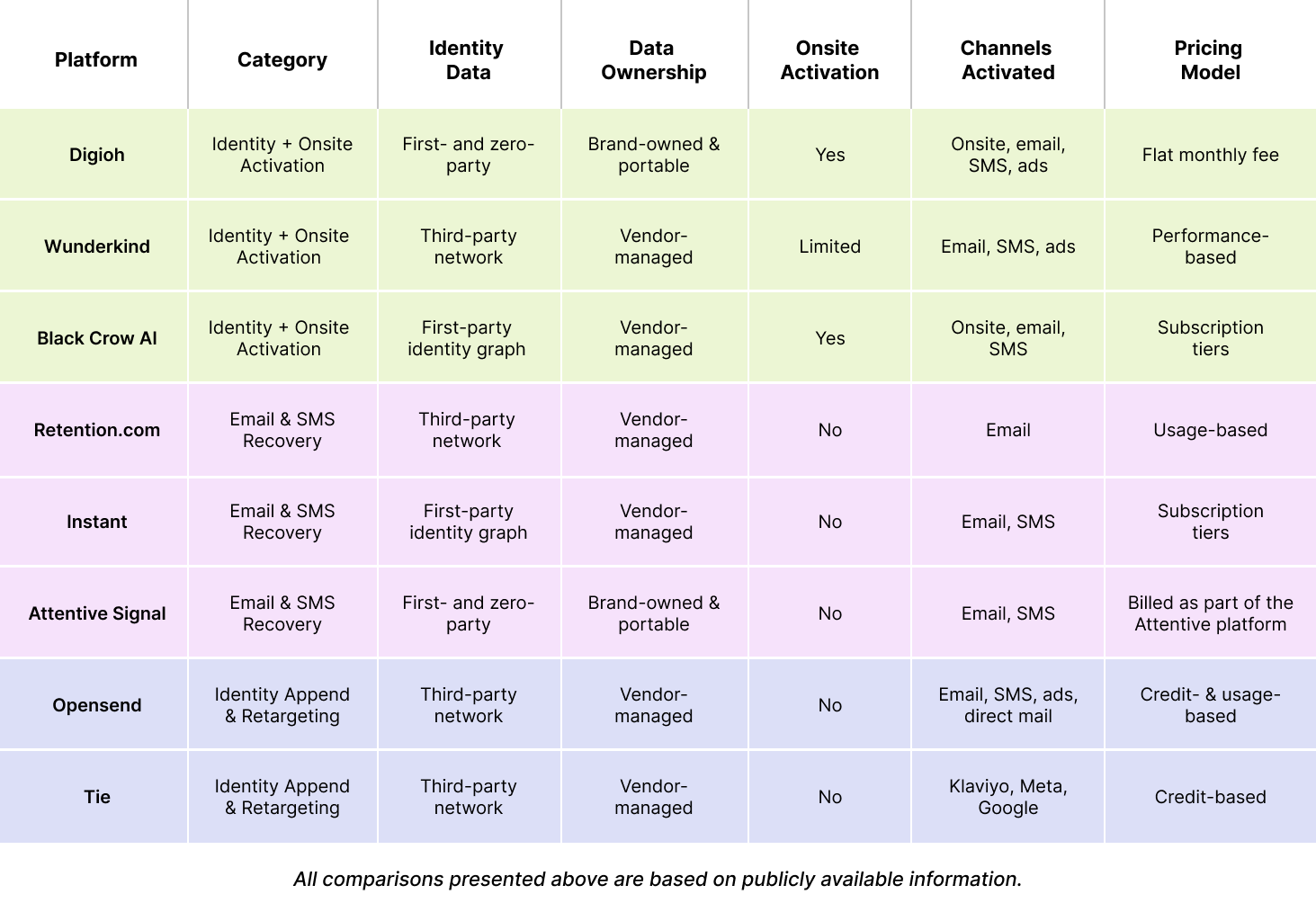
Comparing platforms across ownership, activation, and flexibility often provides a clearer picture than identification rates alone. The table below summarizes the major differences between the three categories and the platforms within them.
The best visitor identification platform depends on your primary goal.
Brands focused on personalization, customer data collection, and long-term customer understanding will often find the most value in an identity and onsite activation platform. These solutions can influence the customer experience while visitors are still browsing and help build richer customer profiles over time.
For teams prioritizing lifecycle marketing, abandonment recovery, and audience growth through owned channels, an email and SMS recovery platform may be a better fit. These tools are designed to identify visitors and activate those audiences after the session ends.
Brands looking to expand retargeting audiences and extend reach across marketing channels may gravitate toward identity append and retargeting platforms, which are built around audience expansion and multi-channel activation.
Company size, available resources, platform requirements, and privacy priorities can also influence the decision.
Enterprise brands may prefer managed-service solutions, Shopify merchants may prioritize platform-native tools, and brands focused on long-term data ownership may gravitate toward first-party and zero-party data collection strategies.
Ultimately, the decision isn't just about identifying more visitors. It's about deciding what kind of customer asset you want to build and how you plan to use that information across your marketing stack.
Digioh helps ecommerce brands identify more visitors, collect valuable first-party and zero-party data, personalize onsite experiences, and activate customer insights across email, SMS, and advertising channels.
Learn more about Digioh's Visitor Identification Suite and how ecommerce brands are using first-party and zero-party data to personalize customer experiences across channels.
Don’t settle for siloed tools. With Digioh, you get one powerful platform for pop-ups, product quizzes, onsite identification, and more—everything you need to personalize every step of the customer journey. Identify more traffic. Collect more zero-party data. Turn insights into revenue.