June 2, 2026

Build Your Own Product Quiz For Free Right Now
Simply give us your website URL and we will build you a completely on-brand product recommendation quiz for free.
There’s a conversation happening a lot in ecommerce right now. You evaluate identity tools, pick one, and move on. Or, you’re already using an identity platform (or a platform that has identity capabilities built in), and the conclusion is that “we’re covered.”
It makes sense because most decisions around martech work exactly like that. You’re solving for a specific problem, and the end goal is typically deciding on a single provider or "the winner" to implement their solution. This strategy is as old as time and leads to a winner-take-all mindset where there's only room for one email sender, one SMS sender, one loyalty platform, one referral provider. You pick the tool that solves it best, and you move on.
Identity works a bit differently because each tool is seeing a subset of your visitors based on how and where it captures identity signals. The goal isn't to have an identity tool. It's to identify as many of your visitors as possible.
The reason identity feels like a one-and-done decision is that all the vendors sound the same. They're all talking about match rates, deterministic matching, probabilistic matching, cross-device stitching, but the underlying technology is largely shared.
What’s different is how each tool identifies visitors. Some rely on shared partner graphs. Some pull from third-party data pools. Some are built around first-party signal capture (e.g., form submissions, quiz completions, tracked clicks). The building blocks are similar, but the methodology varies, and methodology determines who gets identified and who doesn't.
So two identity tools aren't redundant. They're identifying visitors through different means, and the visitors one tool misses, another might catch.
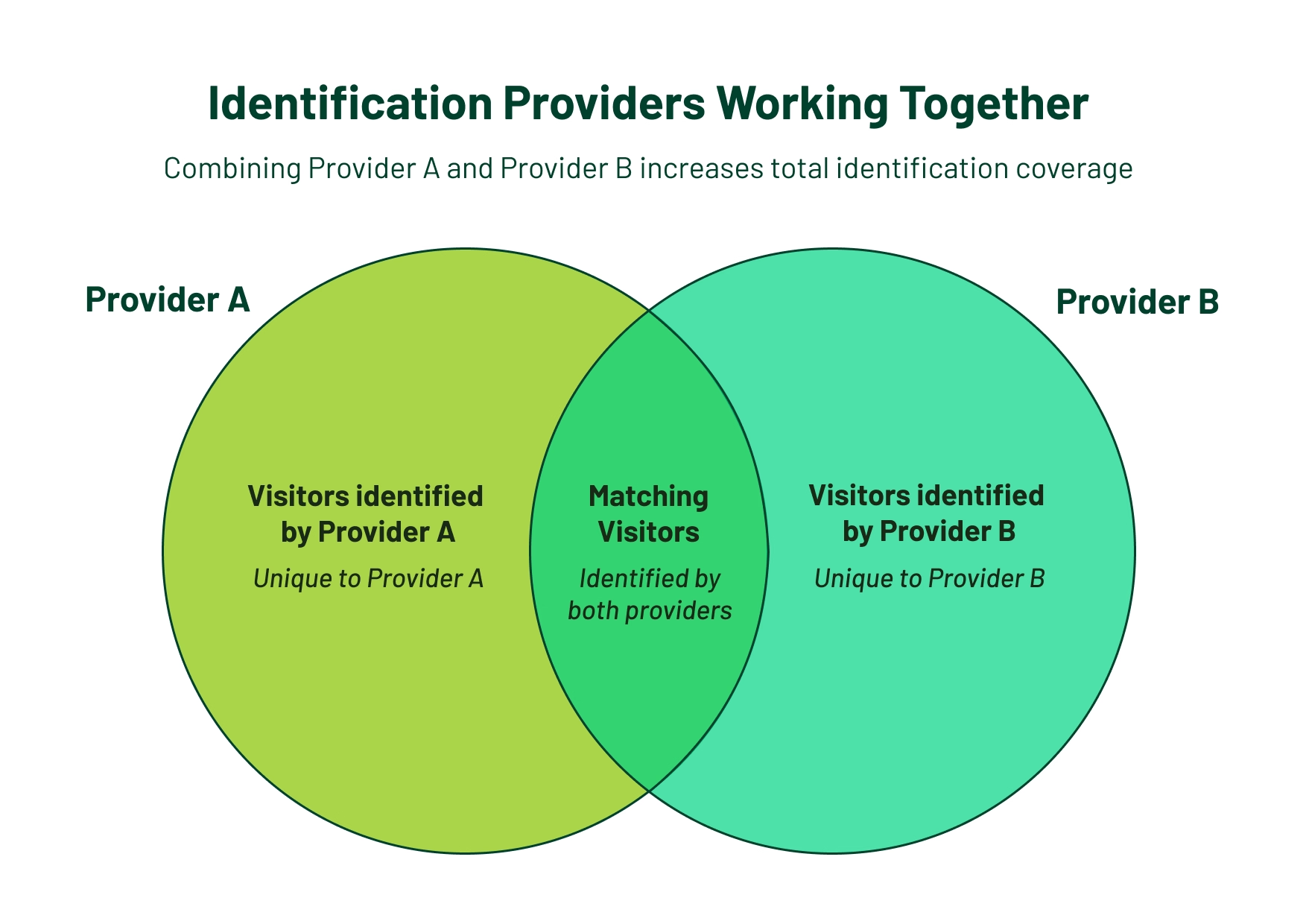
The natural pushback here is cost and complexity. If you're already paying for one identity tool, why add another? The answer should come down to two things: ROI and platform simplicity.
If a second tool identifies enough additional visitors to clear your ROI requirements, and it can run alongside what you already have without a significant lift to implement, the math usually works. You're not replacing anything, but instead you're filling in the gaps.
Different identity tools are built around different moments in the shopper journey. A tool that's strong at recognizing returning subscribers from email and SMS clicks isn't necessarily capturing the visitor who lands from a paid ad cold, or the shopper who submits a quiz or fills out a form for the first time. Those are different signals, captured in different ways.
A few questions worth asking about your current setup:
The identification aspect is only part of the equation. The next question is what happens after someone gets identified. Can you use that data to personalize their on-site experience in real time? Can you feed it into your ESP to trigger flows? Do you own that data outright, or does it live inside a vendor's graph that you're effectively renting access to?
Different tools have different answers to those questions. Some are built purely for recognition. They tell you who's there, but what you do with it is largely up to you and whatever integrations they support. Others are built to activate identity directly, turning recognition into personalized experiences, triggered flows, and measurable revenue.
If there are gaps in either recognition or activation, a second tool might be exactly what’s missing, not because your first is failing, but because it wasn’t built for that.
In the next year or two, most ecommerce platforms will offer some version of identity. It's already happening. Which means "do we have an identity tool" is going to become a less useful question because the answer will almost always be yes.
When every platform does identification, the differentiator becomes the outcome, not the tool. How many of your visitors are you identifying, what are you doing with that data, and is it driving revenue?
When you're focused on outcomes, having more than one identity tool starts to make a lot of sense. Different tools have different methods which means they’re identifying different visitors.
Identity was never a zero-sum game. And the brands that realize it earliest are the ones who win.
Don’t settle for siloed tools. With Digioh, you get one powerful platform for pop-ups, product quizzes, onsite identification, and more—everything you need to personalize every step of the customer journey. Identify more traffic. Collect more zero-party data. Turn insights into revenue.